In the world of high-speed networking, we often focus on the "brain" (the switch) or the "connector" (the transceiver). However, there is a silent hero mounted directly to the PCB that makes high-speed data transmission possible: the SFP Cage.
If you’ve ever wondered why these ports are made of specialized metal or why they get so hot during 10G transfers, you’re in the right place. This guide breaks down the four vital functions of an SFP cage and why hardware quality is non-negotiable for network stability.
★ What Does an SFP Cage Do?
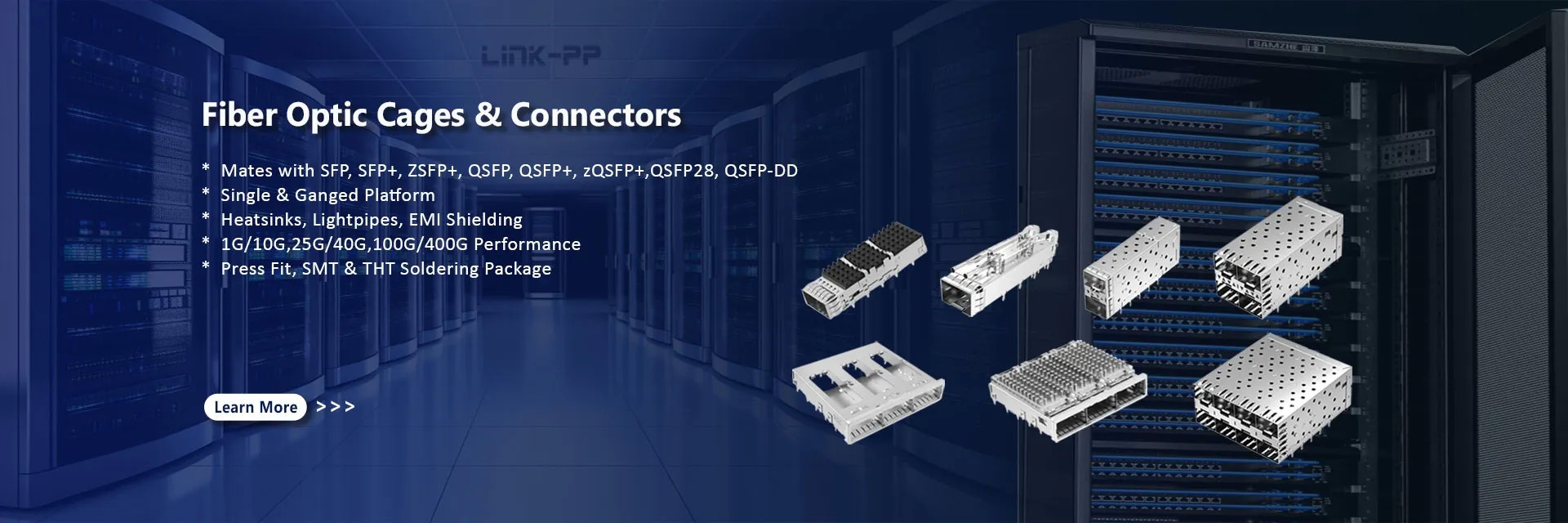
An SFP (Small Form-factor Pluggable) cage is a metal housing that secures transceivers to a circuit board. Its primary functions are mechanical alignment, EMI shielding (Faraday cage effect), thermal dissipation, and ESD grounding.
1. Mechanical Stability and "Blind Mate" Precision
At its most basic level, the SFP cage is a mechanical guide. But when you are dealing with high-density enterprise switches, "basic" isn't enough.
Precision Alignment: The cage ensures the 20-pin gold-finger connector of the transceiver aligns perfectly with the host-side connector on the PCB. A fraction of a millimeter off-center could result in bent pins or a failed link.
Secure Latching: It features a specialized cutout for the transceiver's bail latch. This provides that satisfying "click" that confirms a secure physical connection.
Insertion Life: Professional-grade cages are rated for hundreds of "mate/unmate" cycles, protecting the delicate internal PCB traces from the physical wear and tear of hot-swapping modules.
2. EMI and RFI Shielding: The "Faraday Cage"
As data speeds push past 10Gbps and toward 100Gbps, electromagnetic interference (EMI) becomes a massive hurdle.
The SFP cage acts as a Faraday Cage. It is designed with integrated "EMI spring fingers" that maintain constant electrical contact with the equipment's metal chassis. This prevents high-frequency radio waves generated by the transceiver from leaking out and interfering with other components—a function frequently cited by hardware engineers as the "make-or-break" factor for FCC compliance.
3. Thermal Management: Managing the 10G Heat
If you frequent forums like r/homelab, you’ve likely seen the complaints: "My SFP-to-RJ45 module is hot enough to cook an egg." Modern transceivers, especially copper-based ones, generate significant heat (often 2.5W to 3.0W). The SFP cage serves as a passive heatsink:
Heat Transfer: The metal walls of the cage draw heat away from the module's ASIC and dissipate it into the airflow of the chassis.
Integrated Heatsinks: High-performance cages often come with "heatsink clips" or vented tops to maximize surface area for cooling in fanless environments.
4. Electrical Grounding and ESD Protection
Electrostatic Discharge (ESD) is the silent killer of networking gear. When you plug a module into an SFP cage, the metal housing of the cage is the first thing the module touches. The cage safely shunts any static electricity through its press-fit pins directly to the system ground. This protects the sensitive data pins from receiving a high-voltage shock that could permanently fry the switch's port controller.
★ SFP Cage Variations: Choosing the Right Density
Not all cages are created equal. Depending on your hardware design, you will encounter three main types of SFP Cage:
Cage Type
Configuration
Best Use Case
Single Port (1x1)
Individual housing
Desktop NICs, small routers, and media converters.
Ganged (1xN)
Side-by-side row
Standard 24-port or 48-port enterprise switches.
Stacked (2xN)
Two rows (top/bottom)
Ultra-high-density data center leaf switches.
The "Cheap Cage" Warning
Based on actual user feedback from network technicians, the most common point of failure isn't the software—it’s the EMI fingers.
"I've seen budget switches where the SFP cage fingers were so flimsy they bent inward on the first plug. Not only did it kill the shielding, but it also shorted the module. Always check for a 'snug' fit; if the module wobbles, the cage isn't doing its job." > — Field Lead, r/networking
★ SFP Cage vs. SFP Module vs. SFP Port
Understanding the difference helps avoid common networking confusion:
Component
Function
SFP Module
Converts electrical ↔ optical signals
SFP Cage
Physical + electrical housing interface
SFP Port
Complete interface (cage + electronics + controller)
The cage is not the transceiver—it is the supporting hardware layer that makes transceivers usable in live systems.
★ SFP Cage Compatibility (SFP vs. SFP+ vs. SFP28)
Not all cages support all modules.
Compatibility overview
SFP cages → 1G modules
SFP+ cages → 10G modules
SFP28 cages → 25G modules
Key limitation factors
Backplane design of the device
Signal integrity requirements
Vendor firmware restrictions
Power and thermal constraints
A cage may physically accept a module, but electrical compatibility determines actual performance.
★ PCB-Mounted SFP Cage Design
SFP cages are integrated into PCBs using:
1. Press-fit design
No soldering required
Faster manufacturing
Common in high-volume switches
2. Solder-tail design
Stronger mechanical bonding
Better for high-vibration environments
3. Grounding importance
Proper grounding ensures:
Stable EMI performance
Reduced noise leakage
Reliable high-speed operation
★ FAQ About SFP Cage Functions
1. What is the function of an SFP cage?
An SFP cage provides mechanical support, electrical connection, EMI shielding, and hot-swappable capability for SFP transceiver modules.
2. Does the SFP cage affect network speed?
Indirectly. While it doesn’t process data, poor cage design can cause signal loss or instability at high speeds.
3. Can any SFP module fit any SFP cage?
No. Physical fit may be similar, but electrical and protocol compatibility depends on device design.
4. Why do SFP cages get hot?
Heat usually comes from the transceiver (especially RJ45 copper modules), not the cage itself, though thermal design affects heat dissipation.
5. Is an SFP cage the same as an SFP port?
No. The port includes the cage plus the electronic interface and controller logic.
6. Why are SFP cages always made of metal?
Metal (typically a copper-nickel alloy) is required for both electrical conductivity (for EMI shielding) and thermal conductivity (to act as a heatsink). Plastic housings would allow for massive signal interference and lead to transceiver overheating.
7. Is an SFP+ cage different from a standard SFP cage?
Mechanically, they are nearly identical. However, an SFP+ cage is often built with enhanced EMI shielding and superior thermal materials to handle the higher frequencies and heat generated by 10Gbps+ data rates.
8. What are "Press-Fit" vs. "Solder" cages?
Press-fit cages use compliant pins that are pushed into the PCB holes without solder, making them easier to replace in industrial settings. Solder cages are permanently attached and are typically found in lower-cost consumer electronics.
{
"@context": "https://schema.org",
"@type": "FAQPage",
"mainEntity": [
{
"@type": "Question",
"name": "What is the function of an SFP cage?",
"acceptedAnswer": {
"@type": "Answer",
"text": "An SFP cage provides mechanical support, electrical connection, EMI shielding, and hot-swappable capability for SFP transceiver modules."
}
},
{
"@type": "Question",
"name": "Does the SFP cage affect network speed?",
"acceptedAnswer": {
"@type": "Answer",
"text": "Indirectly. While it doesn’t process data, poor cage design can cause signal loss or instability at high speeds."
}
},
{
"@type": "Question",
"name": "Can any SFP module fit any SFP cage?",
"acceptedAnswer": {
"@type": "Answer",
"text": "No. Physical fit may be similar, but electrical and protocol compatibility depends on device design."
}
},
{
"@type": "Question",
"name": "Why do SFP cages get hot?",
"acceptedAnswer": {
"@type": "Answer",
"text": "Heat usually comes from the transceiver, especially RJ45 copper modules, not the cage itself, though thermal design affects heat dissipation."
}
},
{
"@type": "Question",
"name": "Is an SFP cage the same as an SFP port?",
"acceptedAnswer": {
"@type": "Answer",
"text": "No. The port includes the cage plus the electronic interface and controller logic."
}
},
{
"@type": "Question",
"name": "Why are SFP cages always made of metal?",
"acceptedAnswer": {
"@type": "Answer",
"text": "Metal, typically a copper-nickel alloy, is required for both electrical conductivity for EMI shielding and thermal conductivity to act as a heatsink. Plastic housings would allow severe signal interference and lead to transceiver overheating."
}
},
{
"@type": "Question",
"name": "Is an SFP+ cage different from a standard SFP cage?",
"acceptedAnswer": {
"@type": "Answer",
"text": "Mechanically, they are nearly identical. However, an SFP+ cage is often built with enhanced EMI shielding and superior thermal materials to handle the higher frequencies and heat generated by 10Gbps and above data rates."
}
},
{
"@type": "Question",
"name": "What are Press-Fit vs. Solder cages?",
"acceptedAnswer": {
"@type": "Answer",
"text": "Press-fit cages use compliant pins that are pushed into PCB holes without solder, making them easier to replace in industrial settings. Solder cages are permanently attached and are typically found in lower-cost consumer electronics."
}
}
]
}
★ Final Thoughts
The SFP cage is far more than a "hole in the box." It is a precision-engineered component that manages heat, blocks interference, and protects your hardware from static. When building or buying networking gear, the quality of the SFP cage is a direct indicator of the device’s long-term reliability.
Looking to upgrade your rack? Make sure your transceivers have room to breathe—and a high-quality SFP cage to call home.